Explore three unique garments from the MOHAI collection that showcase the art of visible mending—from 1960s patched bell-bottom jeans to Bill Nye’s hand-repaired shop coat, and the iconic patchwork jacket of J.P. Patches. Learn how mending became both a necessity and a creative statement.
/ July 9, 2025
Pair of bell-bottom jeans with patches, 1968-1980
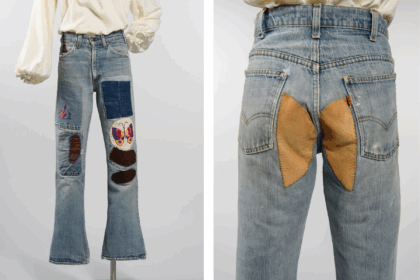
MOHAI, 2015.47.7
Mending served a practical purpose for many centuries—clothing and fabrics were typically expensive, so mending was essential for keeping a wardrobe maintained. Buying new clothing instead of repairing it was historically a sign of affluence.
However, in the 1960s, the “hippie” aesthetic embraced buying secondhand clothing and using visible repairs and decorations to extend the life of a beloved garment. The donor of these jeans, Janet Hesslein, mended and embellished them for over a decade. The mending includes several different techniques and materials, including leather patches and embroidery. This mending was not meant to be hidden or discreet but rather part of the overall aesthetic.
Brown wool shop coat from REI used by Bill Nye, 1980s
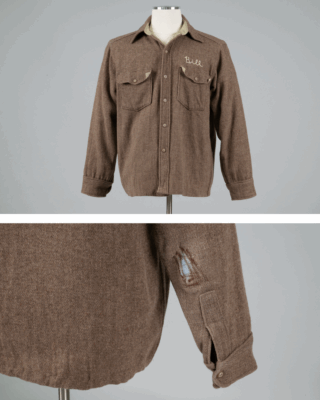
MOHAI, 2024.39.15
Work clothing usually offers the best examples of visible mending because wear and tear on these garments is expected. Here is an example from a recent addition to the MOHAI collection: a “shop coat” that belonged to Bill Nye.
Before he became “The Science Guy,” Nye worked in the Seattle area as an engineer. He needed practical and protective clothing when he would visit the shop and work hands-on with the machinery. This is one of the shop coats he used while working for Sundstrand Data Control. It is a wool jacket from REI which he hand-embroidered with “Bill” on the upper left side. The elbow has been repaired with a denim patch.
J.P. Patches's jacket, 1960-2002
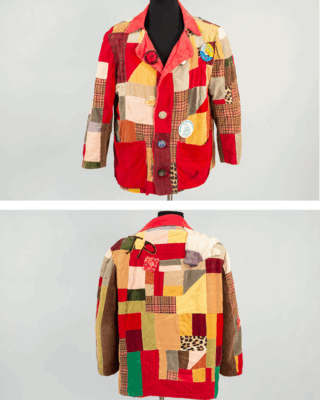
MOHAI, 2003.35.2
Beloved children’s TV character J.P. Patches (played by Chris Wedes) was the mayor of the city dump. Not surprisingly, his clothing had a lot of patches! Over the years there were many versions of J.P.’s clothing made for TV and for public appearances. Sometimes the patches were only in a few places and appeared to actually be covering holes in his clothes, and other times the clothes seemed to be made entirely from patches! Here is one example where there is no clear “background” fabric—the whole structure is an assemblage of fabric scraps of various sizes.