The Alaska-Yukon-Pacific Exposition (AYPE) was a world's fair held in Seattle to publicize the development of the Pacific Northwest. The fairgrounds were designed by the Olmsted Brothers landscape Architecture firm and located on the campus of the University of Washington. The AYPE's amusement park and midway area was located along what is now 15th Avenue, and was called the Pay Streak, a phrase used to describe the richest vein in a mine. Here fairgoers spent considerable time and money, presented with "new mediums of entertainment and opportunities for vicarious travel in other lands" that attempted to instruct and amuse the visitors. With its bright lights an colors, as well as its electric architecture, the Pay Streak contrasted starkly with the stately main exposition.
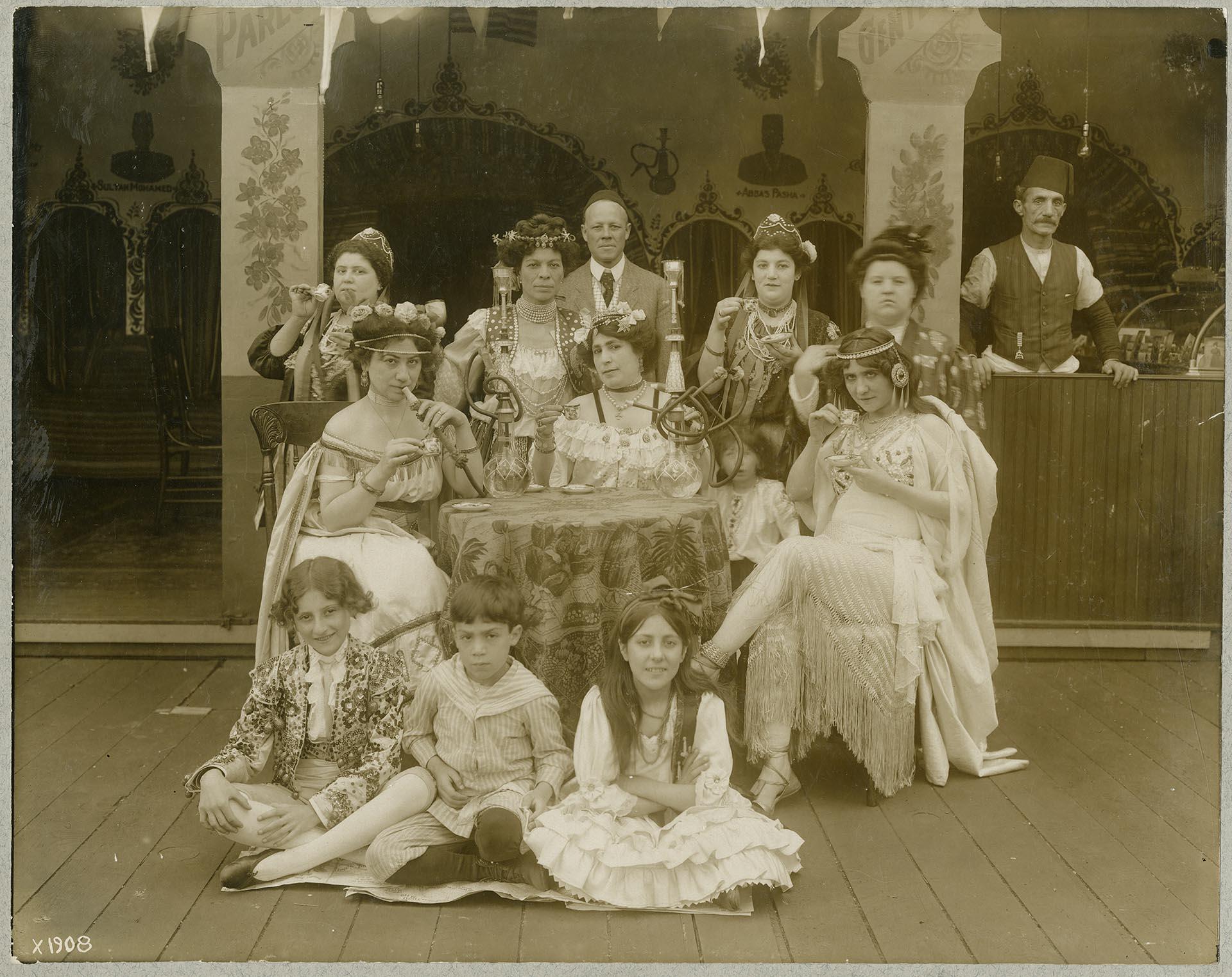
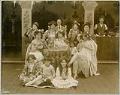
In this image, several Pay Streak performers from the "Streets of Cairo" in the Oriental Village (at that time referring more to the Middle East than to Asia) pose together in costume. The performers were part of a recreation of a "typical" Middle Eastern bazaar. The use of architecture and landscape to tell a specific story was central to the ethnographic villages, frequently a part of world's fairs. In reality, however, the Pay Streak's concessions as well as the fair's main exhibitions reinforced many of the common beliefs of the day: the power of industry to transform savagery into civilization, the United States' role as leader of the industrial world and guardian of the Pacific, and the superiority of white people.
Photographer's number: x1908 Typed on verso: Oriental Village, or Streets of Cairo, performers seated around a table SHS category: A.Y.P. - Paystreak
Caption information source: http://content.lib.washington.edu/exhibits/aype/paystreak.html Caption information source: Chalana, M. (2008). The Pay Streak Spectacle: Representations of Race and Gender in the Amusement Quarters of the Alaska-Yukon-Pacific Exposition. The Pacific Northwest Quarterly, 100(1), 23-36. Retrieved from http://www.jstor.org/stable/40492136
ID Number: SHS7956
Date: 1909
Physical Description: 1 photographic print mounted on cardboard: b&w ; 7.75 x 9.75 in.
Additional Information: Digital copy of this item available thanks to funding from a 2016 Institute for Museum and Library Services grant. Metadata updated as part of a grant from the Institute of Museum and Library Services administered by the Library Services and Technology Act, through the Washington State Library, a division of the Office of the Secretary of State.