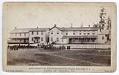
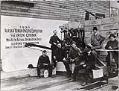
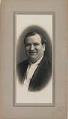
In 1865 the Board of Trustees of Seattle passed Ordinance No. 5 banning Indigenous people from living in the city unless they worked for a non-Indigenous resident and lived on their employer’s property. Despite this attempt to enforce separation between Indigenous people and the settlers, Seattle depended on Indigenous people. Settlers relied on Native people for domestic work and for trade of fish, shellfish, and baskets. Indigenous people from across the Pacific Northwest also harvested hops in agricultural areas to the south and east of Seattle.
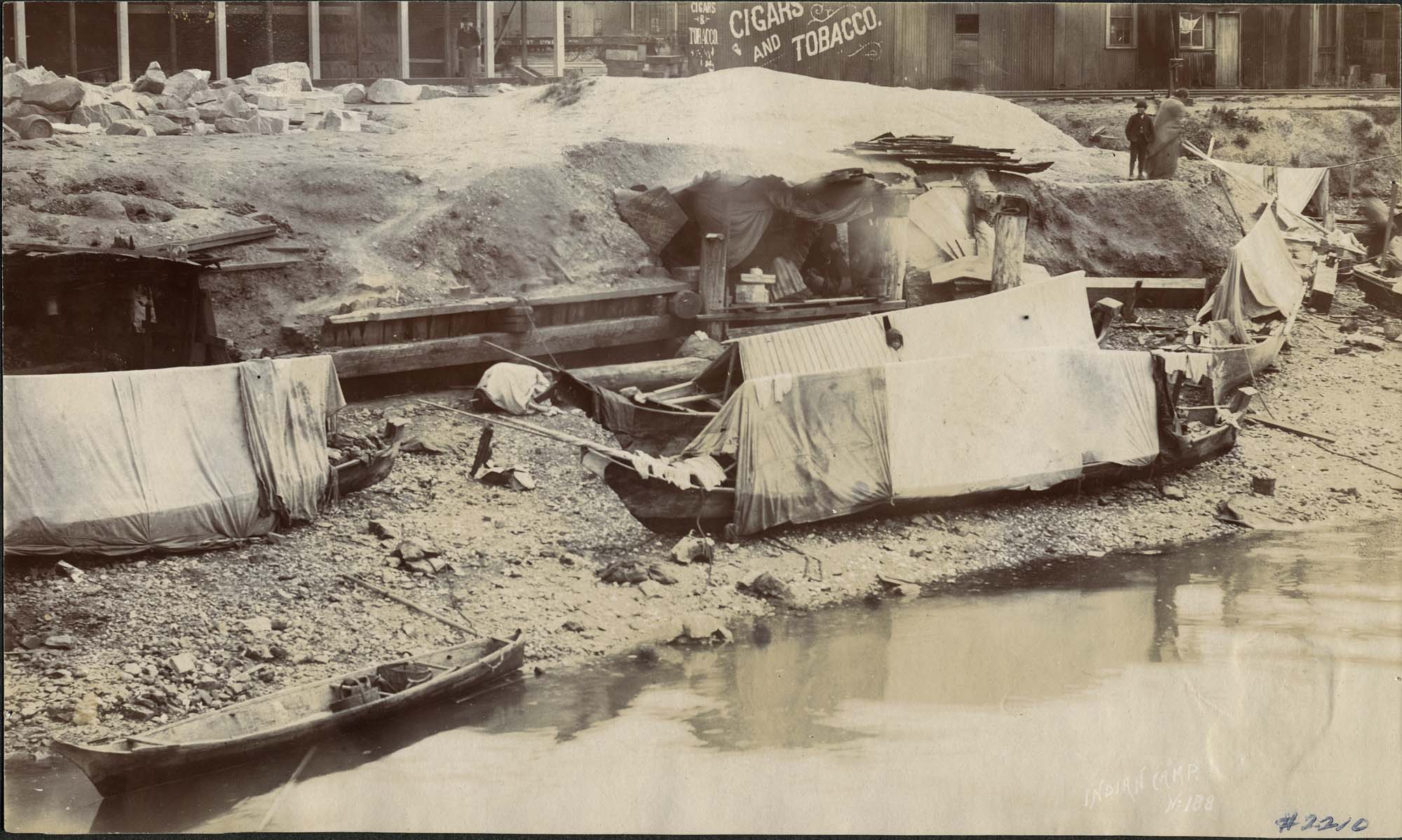
Because they were excluded from the rest of the city, many Indigenous people stayed on Ballast Island, either when passing through, temporarily stopping, or living on the island year-round. Ballast Island was in the harbor at the foot of Washington Street and was created when sailing ships dumped their ballast in Elliott Bay in order to take on cargo. The only place close to Seattle’s business district where Indigenous people were allowed to live, Ballast Island lacked a source of fresh water or permanent structures. As the waterfront grew in the 1890s, Ballast Island was gradually covered and by the time the seawall was built in 1916, the island was almost completely gone and its Indigenous residents had again been displaced.
This image shows canoes beached on Ballast Island, a few of them converted into tents. Dugout shelters are also visible behind the canoes.
Caption information source: “Exile to Ballast Island,” Duwamish Tribe, retrieved from https://www.duwamishtribe.org/exile-to-ballast-island Caption information source: “Seattle Board of Trustees passes ordinance, calling for removal of Indians from the town, on February 7, 1865,” by Jennifer Ott, HistoryLink essay #10979, retrieved from https://www.historylink.org/file/10979
ID Number: SHS2210
Date: Circa 1895
Physical Description: 1 photographic print mounted on cardboard : gelatin, b&w ; 12 x 18 cm.