The Cayuse people historically lived in the Blue Mountains of northeastern Oregon and southeastern Washington, where they fish from rivers that flow into the Columbia. They were in an advantageous position between the coast and the Great Plains, allowing them to trade between both. The Cayuse owned horses in large numbers, which led to their expansion and brought them into contact with tribes on the coast as well as further inland. In 1855, the Cayuse in confederation with the Walla Walla and the Umatilla peoples signed a treaty with the United States. The tribes ceded their land but reserved rights to hunt, fish, and gather at usual and accustomed places. They also reserved the Umatilla Indian Reservation as a permanent homeland. Today, most Cayuse live on the Umatilla Indian Reservation.
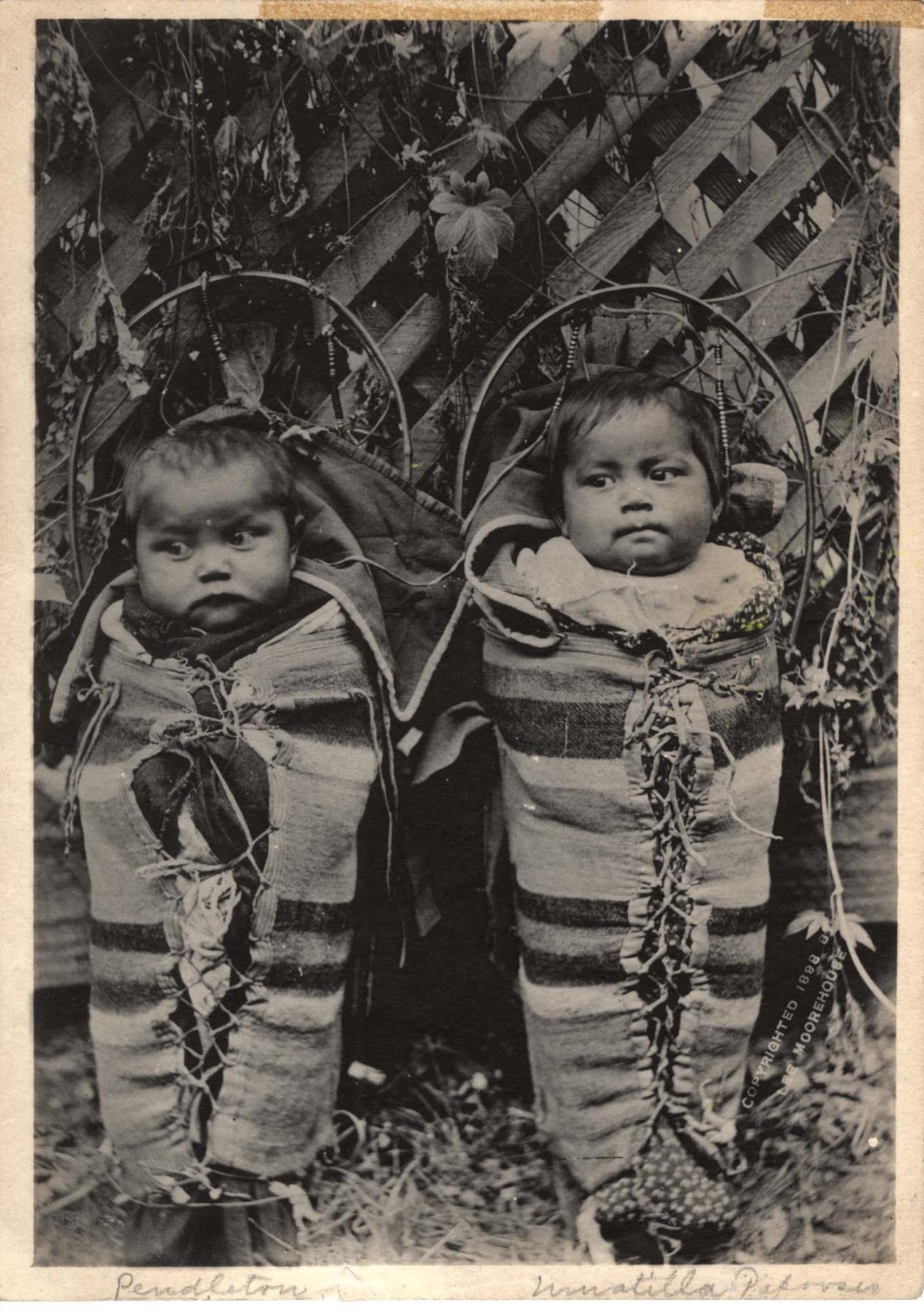
In this photo, Cayuse twins Tax-a-Lax and Alompum (Emma and Edna Jones) look out from their undecorated wood and fabric cradleboards. One source identifies the twins as grandnieces of Chief Joseph, a leader of the Nez Perce people. Various tribes in interior Washington and Oregon traditionally wrapped their infants tightly and laced them into cradleboards. Cradleboards were often made of wood, with a covering of leather or fabric. Some were quite plain while others were highly decorated with beadwork and shells. Women would carry cradleboards in their arms or on their backs, so they could care for infants while performing other tasks.
From 1889 to 1891, photographer Lee Moorhouse served as “Indian Agent” on the Umatilla Reservation, and many of his subjects were members of the Umatilla, Cayuse, and Walla Walla tribes.
Caption on image: "Copyrighted 1898 by Lee Moorehouse" [sic]
Caption information source: "A Brief History of CTUIR," Confederated Tribes of the Umatilla Indian Reservation, retrieved from https://ctuir.org/about/brief-history-of-ctuir/ Caption information source: "Lee Moorhouse: Photographer of the Inland Empire," by Steven L. Grafe, Oregon Historical Quarterly 98, no. 4 (Winter 1997-98): 426-477. Caption information source: “Alompum and Tax-a-Iax, b. 1898. Twin grandnieces of Chief Joseph,” Library of Congress, retrieved from https://www.loc.gov/item/2018648235/