Built on the former site of a Duwamish village, the Naval Reserve Armory was announced in 1937 but trouble with funding delayed completion of the project for several years. The Armory was designed by B. Marcus Priteca, a well-known theater architect, and William R. Grant. The Works Progress Administration, one of the New Deal agencies, constructed the building. Groundbreaking occurred in October 1940, and the attack on Pearl Harbor in December 1941 accelerated the project. The armory was dedicated on July 4, 1942.
During WWII, the Navy bought land around the armory and built additional buildings. At its peak, the Armory site included 25 buildings and had room for 800 trainees. After the war, the Armory was scaled down but it continued to train reservists until the Navy disestablished the site in 1998 and donated it to the city in 2000. In December 2012, MOHAI moved into the Armory building from its original location in Montlake.
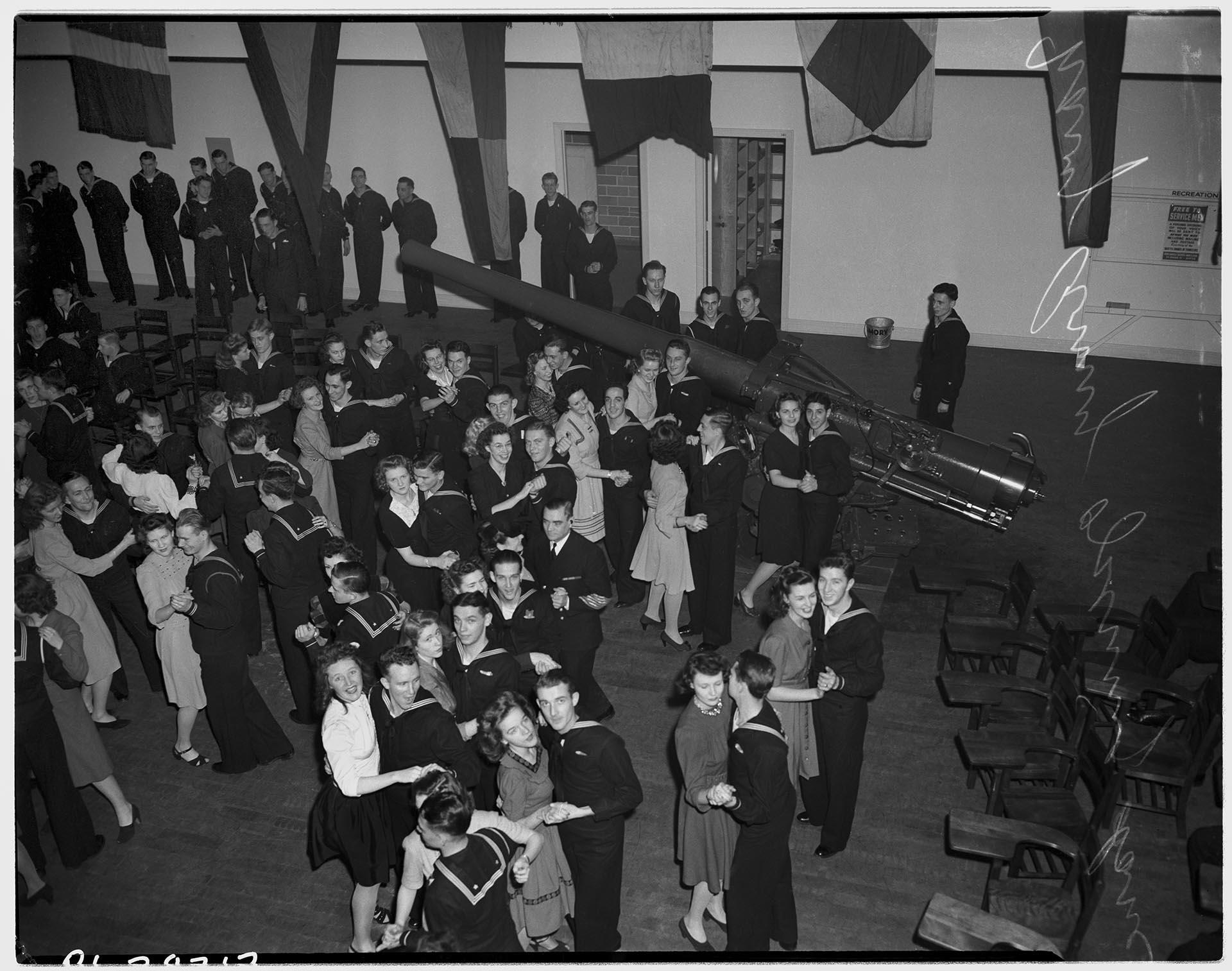
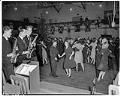
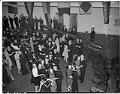
In this image servicemen dance with young women at the Naval Reserve Armory in Seattle while others watch from the sidelines. A large anti-aircraft gun also occupies the dance floor.
Handwritten on negative: Navy Army opening dance Date photograph was filed at the Seattle Post-Intelligencer (date of photograph and file date may differ by a month or more): December 31, 1942
Caption information sources: "City of Seattle Landmark Preservation Board, Report on Designation," https://www.seattle.gov/documents/Departments/Neighborhoods/HistoricPreservation/Landmarks/RelatedDocuments/DesRptNavalReserveArmory.pdf ; "United States Navy (USN), Naval Reserve Building, South Lake Union, Seattle, WA," http://pcad.lib.washington.edu/building/8912/.
ID Number: PI28213
Date: 1942
Physical Description: 1 acetate negative: b&w ; 4 x 5 in.
Additional Information: Digital copy of this item available thanks to funding from a 2016 Institute for Museum and Library Services grant. Metadata updated as part of a grant from the Institute of Museum and Library Services administered by the Library Services and Technology Act, through the Washington State Library, a division of the Office of the Secretary of State.