The Muckleshoot Indian Tribe is made up of descendants of the Duwamish and Upper Puyallup peoples who lived near Puget Sound and its associated waterways since time immemorial. Muckleshoot ancestors lived in villages that were tied together by marriage bonds, trade, shared ceremonies, and use of the same land. This network of interconnected villages extended far beyond the Upper Puyallup and Duwamish tribes, which allowed Muckleshoot ancestors to fish, hunt, and gather across a large area, from the west side of Puget Sound to the Cascade Mountains. The Upper Puyallup and Duwamish tribes signed treaties in 1854 and 1855 respectively, which ceded their land to the United States in exchange for reserving rights to hunt, fish, and gather at usual and accustomed places. The tribes were also promised reservations as permanent homelands. A conflict between the settlers and several Indigenous groups, now called the Puget Sound War, occurred from 1855-56 and in its aftermath a reservation was established on a plain called Muckleshoot at the junction of the White and Green Rivers. After the Muckleshoot Reservation was established, its people gradually came to be known as the Muckleshoot Tribe, instead of by their historical tribal affiliations. Since the early 20th century, the Muckleshoot people have defended their treaty rights, especially fishing rights.
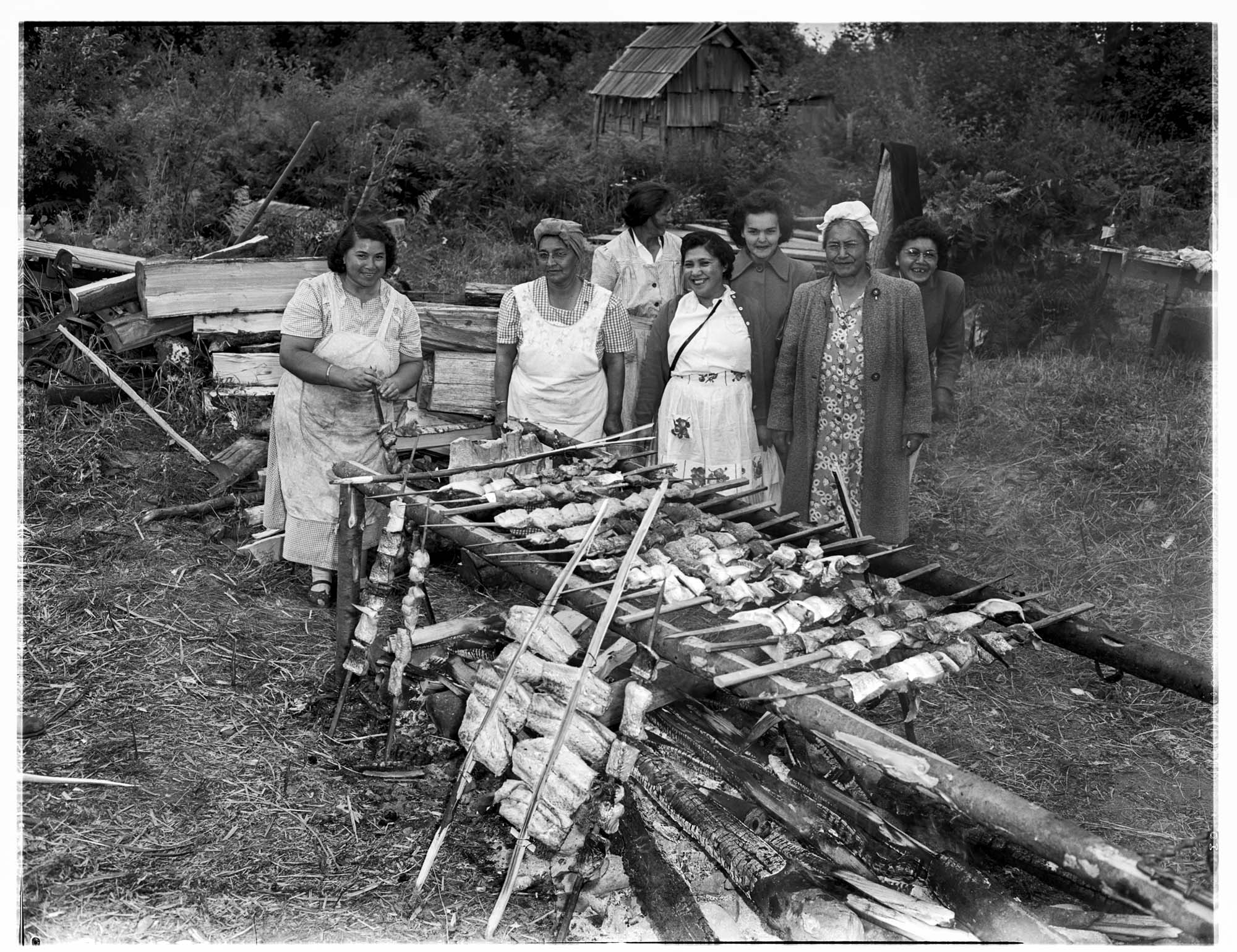
Salmon was historically a mainstay food for the Indigenous tribes of the Pacific Northwest and has remained an important part of their diet. The catching, preparing, and cooking of salmon also remain significant parts of the culture of many Indigenous peoples in Washington. In this photo, several women on the Muckleshoot Reservation help prepare salmon, which has been cut and strung onto sticks and then suspended over an open fire to grill. The wood is probably alder, which gives a distinctive flavor to fresh-cooked salmon and was the preferred fuel.
Note from MOHAI records: Women in image, left to right - Alice Williams, Annie Garrison, unidentified, Genevieve Siddle John, Buna Barr, unidentified, Marie Johnson?, Jackie Swanson.
Caption information source: “History of the Muckleshoot Indian Tribe and its Reservation,” Muckleshoot Indian Tribe, retrieved from http://www.muckleshoot.nsn.us/about-us/overview.aspx.
ID Number: PI23907
Date: Circa 1950
Physical Description: 1 negative : safety film, b&w ; 4 x 5 in.