Many American jazz musicians traveled to Shanghai during the city's golden age in the 1930s, when "the Paris of the Orient" was the newest horizon on an increasingly international jazz music scene. For Black musicians, who were often excluded from white musicians' unions in the U. S. and subjected to other forms of segregation, Shanghai provided steady, well-paid work, and greater respect than they received in most American venues outside the Black community.
Louisiana-born saxophone player and bandleader Earl Whaley moved from San Francisco to Seattle around 1930 and led one of the first swing bands on the West Coast, The Red Hot Syncopators. With Whaley on tenor and alto saxophones, the band also featured Seattle musicians Palmer Johnson, Wayne Adams, Earl West, Oscar Hurst, Fate Williams, and Punkin Austin. In 1934, Whaley took his band to Shanghai, where the Syncopators played and grew famous in St. Anna’s Ballroom and other clubs until 1937, when many musicians shipped out after the Japanese occupation of Shanghai. Earl Whaley stayed on, with a mix of old and new band members, and continued to perform until he and others from his band were imprisoned by the Japanese Army between 1941 and 1945.
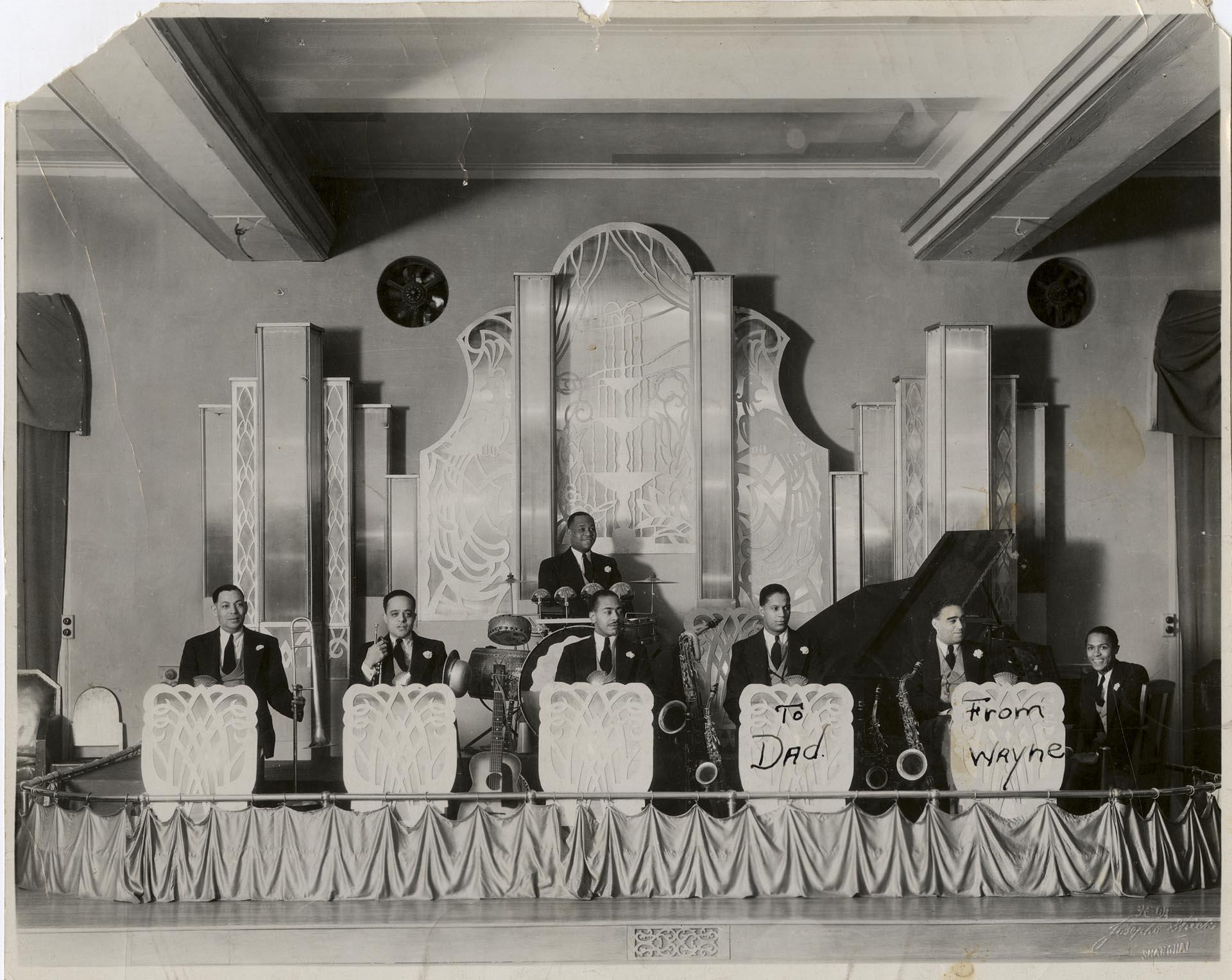
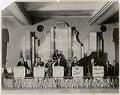
This photo shows the original Earl Whaley band members in Shanghai, identified from left as Fate Williams on trombone, Oscar Hurst on trumpet, Punkin Austin on percussion, Earl West on guitar, Wayne Adams on sax, Earl Whaley, and Palmer Johnson on piano.
Handwritten on photo: To Dad From Wayne. Handwritten on verso: Taken Dec. 20, 1934. Going over big in Shanghai, China. Earl Whaley's Band.
Caption information source: "The Blue Note: Seattle’s Black Musicians' Union, A Pictorial History" by David Keller, at the All About Jazz website. Caption information source: "Earl Whaley Band" at BlackPast.org website. Caption information source: "Jazz in Occupied China: Black Jazzmen at the Japanese Prison Camp in Weihsien, China during World War II" by Desmond Power at blackpast.org.
ID Number: 2016.84.2.10.1
Date: 1934
Physical Description: 1 photographic print : b&w ; 8 x 9.75 in.
Additional Information: Digital copy of this item available thanks to funding from a 2016 Institute for Museum and Library Services grant.
Credit: MOHAI, James E. Adams Family Photographs, 2016.84.2.10.1