Back to Results
Photograph
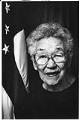
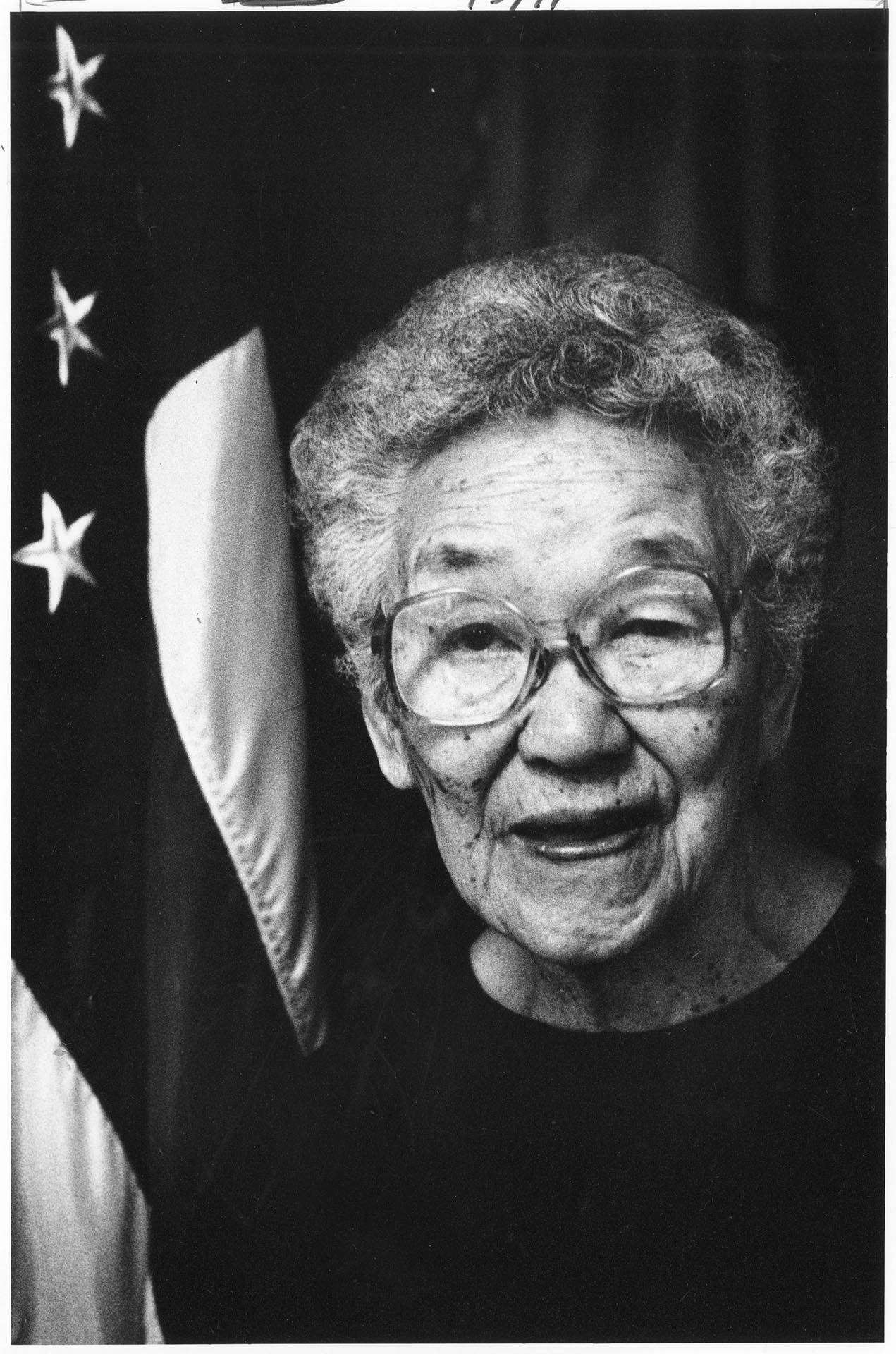
Kotaka Uomoto at Nisei Veterans Hall, Seattle, September 21, 1988
Order an ImageThis photo shows Kotaka Uomoto posing in front of an American flag at the Nisei Veterans Hall in Seattle, where she participated in a twice-weekly nutrition program for Japanese senior citizens.
Kotaka (1896-1993) and her husband Hyokichi Uomoto (1883-1965) arrived in Washington from Japan in 1916 and settled in Seattle. The couple had four sons: Yoshinori George (1919-2004), Kiyoshi Robert (b. 1921), Mamoru Ted (1923-1982), and Masuru Sam (1925-2008). According to the 1930 census, the family lived on Dearborn Street, with Hyokichi working as a hotel proprietor, and Kotaka as a hotel housekeeper. The family later lived at 1206 Howell Street until 1942, when they were forcibly removed to the Puyallup Assembly Center, euphemistically called “Camp Harmony,” and eventually incarcerated at Minidoka Relocation Center in Idaho. At least three of the four Uomoto sons served in the U.S. Army.
The building housing the Nisei Veterans Hall (or Nisei Veterans Committee Memorial Hall), at 1212 S. King Street, was constructed in 1938 as a Japanese martial arts dojo. Vacant during the WWII years, when the Japanese American community was incarcerated in camps, in 1951 it became the property of the Nisei Veterans Committee, established in 1946 as a place of camaraderie for Nisei veterans, as discrimination and racism prevented their membership in other veterans’ organization.
Caption information source: Ancesty.com
Caption information source: "He's not their emperor, but he still gets respect" by Evelyn Iritani, Seattle Post-intelligencer, September 26, 1988, p. 2
Kotaka (1896-1993) and her husband Hyokichi Uomoto (1883-1965) arrived in Washington from Japan in 1916 and settled in Seattle. The couple had four sons: Yoshinori George (1919-2004), Kiyoshi Robert (b. 1921), Mamoru Ted (1923-1982), and Masuru Sam (1925-2008). According to the 1930 census, the family lived on Dearborn Street, with Hyokichi working as a hotel proprietor, and Kotaka as a hotel housekeeper. The family later lived at 1206 Howell Street until 1942, when they were forcibly removed to the Puyallup Assembly Center, euphemistically called “Camp Harmony,” and eventually incarcerated at Minidoka Relocation Center in Idaho. At least three of the four Uomoto sons served in the U.S. Army.
The building housing the Nisei Veterans Hall (or Nisei Veterans Committee Memorial Hall), at 1212 S. King Street, was constructed in 1938 as a Japanese martial arts dojo. Vacant during the WWII years, when the Japanese American community was incarcerated in camps, in 1951 it became the property of the Nisei Veterans Committee, established in 1946 as a place of camaraderie for Nisei veterans, as discrimination and racism prevented their membership in other veterans’ organization.
Caption information source: Ancesty.com
Caption information source: "He's not their emperor, but he still gets respect" by Evelyn Iritani, Seattle Post-intelligencer, September 26, 1988, p. 2
ID Number: 2000.107.098.20.01
Date: 1988
Creator(s):
Jones, Jennifer Werner, Photographer
Physical Description: 1 photographic print : b&w ; 8 x 10 in.
Credit: MOHAI, Seattle Post-Intelligencer Collection, 2000.107.098.20.01, photo by Jennifer Werner Jones
Copyright: All Rights Reserved