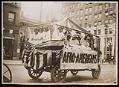
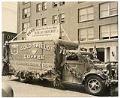
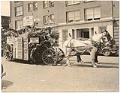
The Tilikums of Elttaes were a fraternal, civic organization composed primarily of influential white Seattle area businessmen, who used Native American imagery to promote tourism and the economic development of the city. In July 1911 the Tilikums ("Friends" in Chinook Jargon; Elttaes is Seattle spelled backward) organized the first Golden Potlatch celebration. The Golden Potlatch was a city-wide festival held in July organized by civic boosters hoping to capitalize on the success of the Alaska-Yukon-Pacific Exposition of 1909. The event continued for each of the next three summers before being suspended during wartime, and then was started up again as the Potlatch Festival from 1934 to 1941.
The name “Golden Potlatch” appropriates a Chinook Jargon word describing a Native ceremony of celebration and gift giving. It also reflects the importance of the Klondike gold rush to Seattle’s growth. Many organizers and participants in the Golden Potlatch dressed in stereotyped imitations of traditional Native attire, as part of a created Potlatch myth. The appropriation of Native culture in order to market products or events was one common example of discrimination and marginalization faced by Native peoples in the United States.
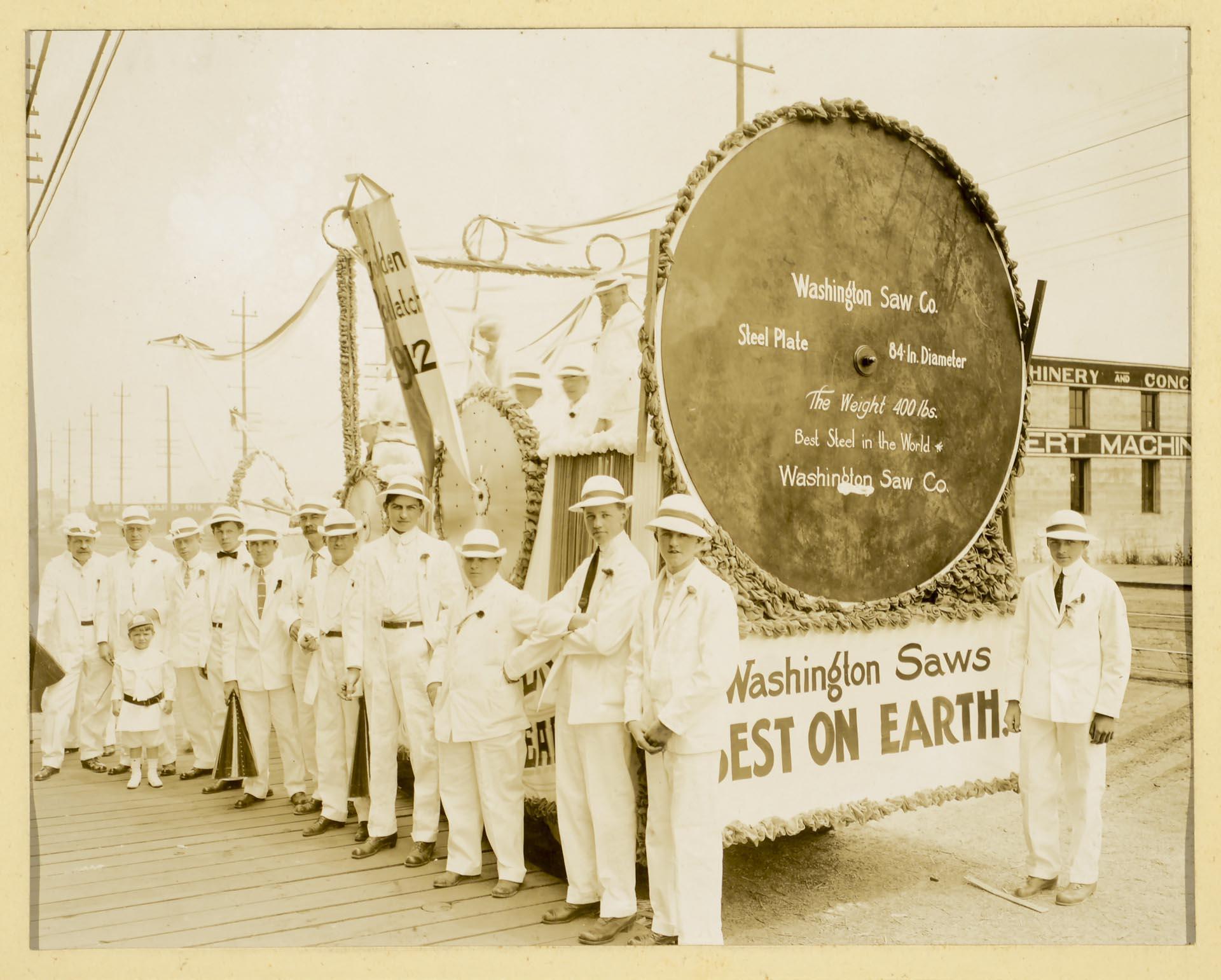
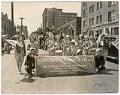
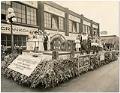
Organizers of the 1912 Golden Potlatch decided to give the annual parade an industrial focus. Here, a group of men and one young boy gather at the Mercantile Lumber Company float, which featured circular saw blades and a large steel plate, all made by the Washington Saw Company. The men who rode on the float hammered on the steel saws as they moved along the parade route.
Writing on saw in image: Washington Saw Co. Steel Plate. 84 in. Diameter. The Weight 400 lbs. Best Steel in the World. Embossed on mat recto: Pierson & Co., Seattle
Caption information source: The Seattle Daily Times, July 20, 1912.
Physical Description: 1 photographic print mounted on cardboard : b&w ; 9.5 x 7.5 in.
Additional Information: Digital copy of this item available thanks to funding from a 2016 Institute for Museum and Library Services grant. Metadata updated as part of a grant from the Institute of Museum and Library Services administered by the Library Services and Technology Act, through the Washington State Library, a division of the Office of the Secretary of State. View the finding aid for this collection at https://archiveswest.orbiscascade.org/ark:80444/xv00703
Credit: MOHAI, Owen L. Hall Lumber Industry Photograph Collection, 1981.7351,159, photo by Pierson and Co.