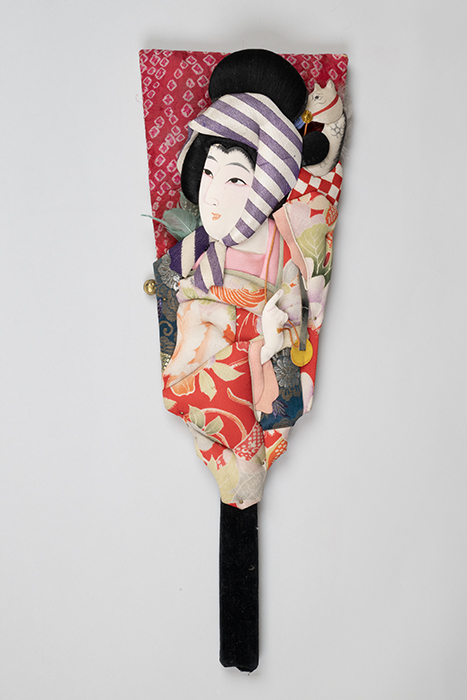
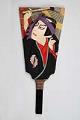
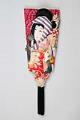
This paddle is called "Hagoita" and is associated with a game called Hanetsuki. These highly decorative versions are usually not used for play but are given as a good luck gift to girls on their first New Year.
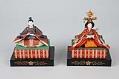
In 1942, the majority of the student body of the Bailey Gatzert Elementary School was of Japanese descent and all of these children were incarcerated during WWII. Because they were able to take so few belongings with them, many of the students gave their Boys’ Day and Girls’ Day dolls to their principal, Miss Ada Mahon, for safekeeping. Even though they aren’t associated with Girls’ or Boys’ day, two Hagoita were also part of this collection. Like the Boys’ and Girls’ day items, the Hagoita were prized possessions that belonged to these children. The collection remained at Bailey Gatzert from 1942 until 1973, when they were given to the Museum of History & Industry.
This story of lost dolls and lost memories highlights the deep experience of cultural and physical loss of the Japanese American community during the WWII incarceration. In 2001, nearly 60 years after the dolls were given away, members of the Yutani family, including Massie (née Yutani) Tomita, came to see if they could identify any of the dolls. While they could not identify them precisely, this was the first moment that these dolls were reconnected with their original owners. Massie Yutani Tomita and her family were incarcerated at Minidoka while she was a high school student.
ID Number: 1973.5711.41
Date: 1930-1940
Physical Description: 1 Doll, Decorative; wood, velvet, brass, silk, feathers; 18.25 in.H x 6.25 in.W x 2.25 in.D