If you haven’t yet visited MOHAI’s exhibit Teamsters, Turtles, and Beyond: The Legacy of the Seattle WTO Protests you might wonder why “turtles” is featured so prominently in the title. But if you’ve seen the exhibit, you know that turtles played a large role in the WTO protests and are featured prominently in the exhibition.
/ April 2, 2025
People in turtle costumes dancing at WTO protest, Seattle, November 29, 1999
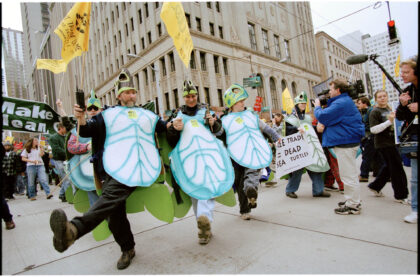
MOHAI, Seattle Post-Intelligencer Collection, 2000.107.19991129.22.33, photo by Paul Joseph Brown
Soon after it was announced that the WTO would meet in Seattle there was a meeting of potential protesters, including members of the organizations Animal Welfare and Art & Revolution. They discussed ideas for eye-catching and message-driven costumes that would draw attention to their organizations.
Crowd of turtle-clad demonstrators headed for the WTO protest march, Seattle, 1999
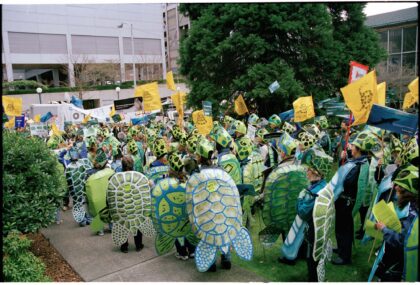
MOHAI, Ervin Schleufer Photographs, 2024.54.07.11
One timely issue was the fate of tens of thousands endangered sea turtles killed in cheap shrimp nets. The WTO had recently overruled a U.S. regulation banning the import of shrimp harvested in such nets, saying that the protection was a barrier to free trade. During the organizing meeting, David Soulnit of Art & Revolution folded a piece of paper to create a turtle carapace (which includes a turtle’s shell and skeleton), and Bryan Barnard made a small cardboard model. But it was Ben White, a member of Animal Welfare, that saw the vision through.
White was known for headline-grabbing actions like sleeping in old-growth trees in the Pacific Northwest to protest logging and cutting open dolphin-holding nets in Japan. He spent six months collecting and cutting cardboard and organizing more than a dozen work parties to create over 240 turtle costumes.
The Turtles Suit Up
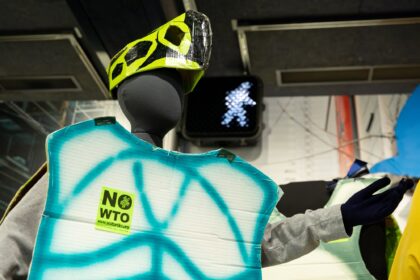
Photo Credit: Nikki Womac
The costumes were distributed to protesters at First United Methodist Church. The police were concerned about the costumes, particularly that the headpieces could cover the faces of the demonstrators. But the design of the headpieces meant that they were worn more like a hat than a mask. Additionally, anyone issued a turtle costume was on strict orders not to engage in any kind of violence—even arguing would result in the loss of a costume.
Turtles in the MOHAI Collection
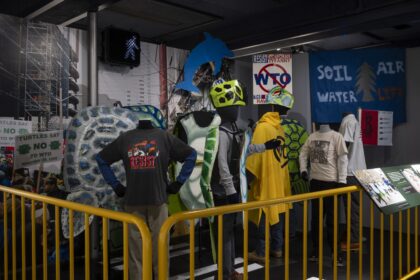
Photo Credit: Aurora San Miguel
MOHAI was fortunate to acquire multiple original costumes, which showcase the handmade variety in the construction and decoration of each costume. The turtles consist of three parts: a back shell (carapace) which also included hind flippers, a front shell (plastron), and a headpiece with cut-out eyes and a beak. The front and back shells were connected with ties at the shoulders and at the sides. On several costumes, the plastron is decorated with protest stickers or other additions. The design on the plastron was mostly spray painted whereas the back shells appear to be hand done with brushes and other tools, some more hastily painted while others are highly detailed.
With over 240 turtles marching in the streets, the costumes quickly became a symbol of the WTO protests. Explore more images and artifacts from the protests in the MOHAI Collection.