Roy and Elise Olmstead were at the center of one of Seattle’s most operatic stories. Known as “Bootlegging Royalty,” their story includes tails of radio messages, flipped informants, salacious trials, and religious conversions.

Explore part of their story through photographs in the MOHAI collection below.

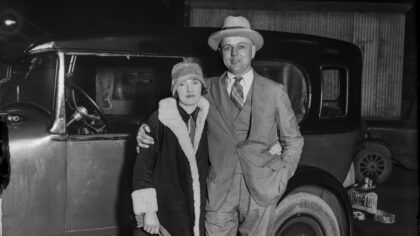
Elise and Roy Olmstead, 1925

A historic, black and white photo of two people standing in front of a car.

MOHAI, Seattle Post-Intelligencer Collection, 1986.5G.2261.1

Roy Olmstead (1886-1966), shown here with his second wife Elise Olmstead, was one of the Seattle area’s most prolific bootleggers. Olmstead took what he learned from his time enforcing prohibition laws as a Seattle Police Lieutenant started his own bootlegging gig. His operation grew to include various vessels and trucks for transportation, warehouses for storage, and employees for importing liquor from Canada.

As the business grew, federal agents began to take notice. They began to surveil Olmstead and his associates and arrested Olmstead, his wife, and nine other individuals in 1924 as a result of their wiretapping efforts.

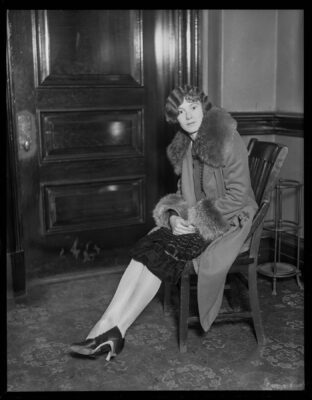
Elise Olmstead, circa 1926

Elise Olmstead seated in front of a fireplace wearing a fur jacket.

MOHAI, Seattle Post-Intelligencer Collection, 1986.5G.2278.1

Elise Olmstead (1899-1979) was the second wife of Roy. Born in London, England in 1899 as Elsie Parsche, Elise originally immigrated to Vancouver, Canada. She spent a few years moving back and forth across the border and by 1922 she was living full-time in Seattle as Elsie Campbell.

Elise soon began working for Roy Olmstead as a bookkeeper, where she became an informant for the government against Roy’s bootlegging operation. At some point during this time, Elise became romantically involved with Roy and stopped working as an informant. Roy divorced his first wife in 1924, and the couple married. They had one daughter, Patricia, in 1925.

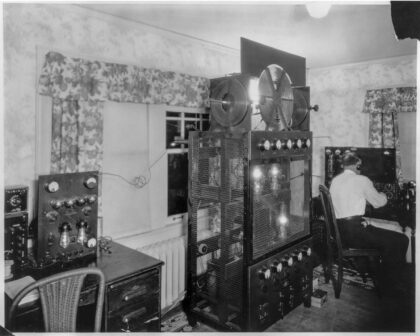
Radio station KFQX in Olmstead home, 1924

1920s radio broadcasting equipment inside the Olmstead home, showing a man operating the transmitter for KFQX station suspected of sending coded messages during Prohibition.

MOHAI, 1987.30.1

Roy and Elise Olmstead purchased a large home in the Mount Baker neighborhood in 1924. They started a commercial radio station called KFQX in a spare room of their residence. Elise read children’s stories that were on air, and Prohibition agents speculated that the stories contained coded messages for rumrunners. In 1924, agents raided the home and Roy and Elise were arrested. The man in this photo is probably Roy Olmstead.

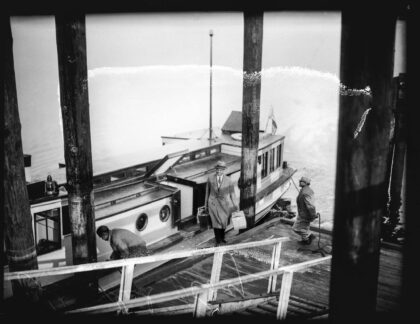
Roy Olmstead in a boat arriving at a dock, 1931

Roy Olmstead stepping off a boat at Steilacoom landing in 1931, the day of his release from McNeil Island Penitentiary after serving time for bootlegging.

Roy Olmstead in a boat arriving at a dock, 1931
MOHAI, Seattle Post-Intelligencer Collection, 1986.5G.2269.1

The Federal Grand Jury indicted the Olmsteads in 1925. The trial began in 1926 and was the largest in the country’s history of liquor violations, with 47 original defendants. Elise was eventually acquitted, but Roy was convicted and sentenced to four years in prison and fined $8,000. He appealed his conviction in a 1928 landmark case on the grounds that wiretapping was unconstitutional based on the 4th and 5th Amendments. After losing his appeal, Roy served his time at McNeil Island Penitentiary and was released May 11, 1931.

This photograph of Roy leaving the prison launch was taken on the day of his release when he arrived at Steilacoom landing.

Roy converted to the Christian Science faith while incarcerated and believed alcohol to destructive by the time of his release. Roy spent his remaining years counseling and teaching from the Bible, providing rehabilitative services to Puget Sound inmates, and operating a ministry from the Times Square Building. Elise filed for divorce in 1943 claiming desertion.
Categories:
Food

Related Blog Posts

Historic black and white photo of John
November 29, 2010

MOHAI Minute: Doc Hamilton and Prohibition

Learn about prohibition in Seattle and the impact of John “Doc” Hamilton’s restaurant and speakeasy, The Pit, in this installment…
Read More
Historic black and white photo of the exterior of the Alaska Cigar Shop and Café featuring the lower half of the iconic Alaskan stained glass window.
October 18, 2010

MOHAI Minute: Alaska Café Stained Glass Window

Learn about a stained glass window that dates back to the Klondike Goldrush and the major restoration work involved in…
Read More