It’s been a busy year for the MOHAI collections team! Each year, staff comb through hundreds of donation offers in search of artifacts to add to MOHAI’s permanent collection.

The decision to accept an artifact into the collection is made carefully. The collections team must consider the items already part of the MOHAI collection, then prioritize the gaps that need to be filled.

For example, newer artifacts (from the last 40 years) are offered less frequently than older artifacts (50 years or more). People of Color, Indigenous People, gay or queer people, trans and nonbinary people, immigrants not from Europe, refugees, people with disabilities, minority religious groups, and working class and low-income people are underrepresented in the collection and are priorities for collecting.

All the artifacts accepted by the collections team work together to tell the story of Seattle and the Puget Sound region, from the mid-19th century to the present day. Below is a selection of artifacts added to the MOHAI collection in 2024.
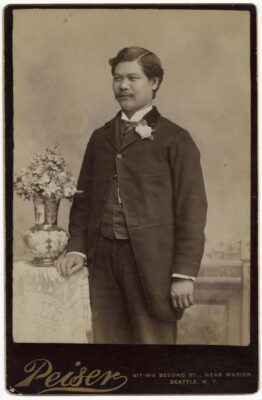
Mark Ten Suie Trading Company Collection

Mark Ten Suie, a Chinese American merchant who lived and worked in Seattle from 1876 through the 1920s show posing in suit circa 1885.

Mark Ten Suie, shown here in the 1880s, was a Chinese American merchant who lived and worked in Seattle from 1876 through the 1920s. This collection from the Mark Ten Suie Trading Company documents the short-run business that Mark Ten Suie co-owned with J.W. Kahle, one of the owners of the Crescent Manufacturing Company in Seattle, and local businessman H.T. Stoel, Jr.

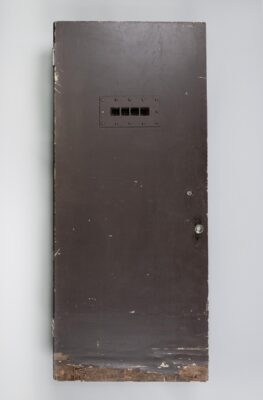
Door from John "Doc" Hamilton's speakeasy in Seattle, ca. 1920s

Door from John "Doc" Hamilton's speakeasy in Seattle, ca. 1920s.

Door from John “Doc” Hamilton’s speakeasy in Seattle, ca. 1920s
MOHAI, Gift of Alan Scharhon, 2024.27.1

This prohibition-era speakeasy door, complete with a sliding peephole, is from Doc Hamilton’s Barbeque Pit. John Henry “Doc” Hamilton (1891-1942) opened his first speakeasy in his home on E. Union Street. Seattle police shut it down in 1924, and this was the first of numerous illegal clubs that he opened and had run-ins with local law enforcement. The Barbecue Pit was Hamilton’s most famous and elegant club whose patrons included Seattle businessmen, judges, and politicians including the mayor, Edwin J. Brown.

This door was in the basement of the Barbecue Pit, also known as the 908 Club, which was located at 908 12th Avenue in Seattle.

Morningside Dairy Collection

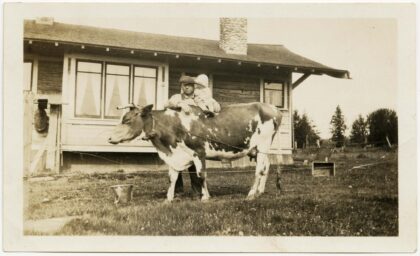
Franz Hardow holding his daughter on a cow, circa 1926 in front of their single story home.

Franz Hardow holding his daughter on a cow, circa 1926
MOHAI, Morningside Dairy Collection, 2024.6.5

Located on present-day View Ridge Playfield, Morningside Dairy was a small family business operating in Seattle from around 1922 until 1948. Owned by Franz Hardow (1886-1965) and Anna Gerrels Hardow (1894-1990), the Hardows raised cows and chickens, and made a living selling milk and eggs to their customers for over 20 years. Their daughter Frances, born in 1925, grew up on the farm and attended Bryant School in the nearby Ravenna neighborhood.

This collection includes photos of the dairy, dairy reports, and letters about life on the farm during World War II.

Canoe paddle carved by Emmett Oliver (Swinomish), 1934

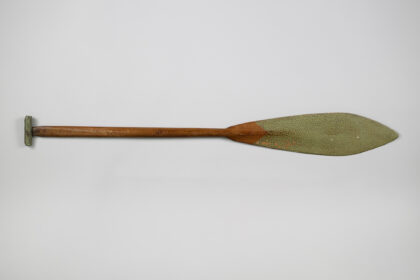
Canoe paddle carved by Emmett Oliver (Swinomish), 1934.

Canoe paddle carved by Emmett Oliver (Swinomish), 1934
MOHAI, Gift of Marylin Oliver, 2024.55.1

This canoe paddle was carved by Emmett Oliver of the Swinomish Tribe. It was on loan for the exhibit Pulling Together: A Brief History of Rowing in Seattle and then generously donated to MOHAI when the exhibit closed.

Oliver raced in the Lone Eagle dugout canoe during the annual Canoe Race of 1934. The Lone Eagle would be the same boat that raced against the UW crew in the 1941 Great Race. Long before white settlers introduced rowing to this region, Coast Salish tribes paddled the waterways and raced each other in canoes. While potlach gatherings were banned, canoe racing allowed local tribes to gather socially—eventually becoming a spectacle for white crowds.

Bill Nye Collection

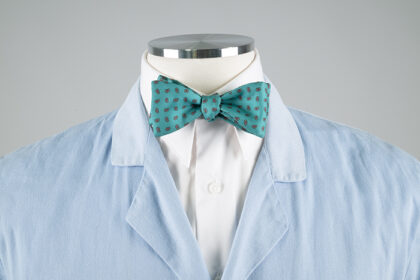
Green bow tie, used in "Fabulous Wetlands" educational video featuring Bill Bye, 1989.

Green bow tie, used in “Fabulous Wetlands” educational video, 1989
MOHAI, Gift of Bill Nye, 2024.39.16

This year, Bill Nye donated a large collection of objects and documents to MOHAI. The collection spans several eras of his life in Seattle, from working as an engineer in the late 1970s and early 1980s, to his comedy career including on Almost Live!, and of course his iconic “Bill Nye the Science Guy” TV show. One object that bridges a key part of his story is this bow tie which is on display in Almost Live! Almost An Exhibit.

In 1989 the Washington State Department of Ecology wanted to create an educational video about wetlands. They hired Nye because of his comedic science demonstrations on Almost Live! and he wore this bow tie in the video. The producers of Fabulous Wetlands were Erren Gottlieb and former Almost Live! staff member Jim McKenna. Gottlieb and McKenna would later co-create the TV show Bill Nye the Science Guy with Nye.

Chapman Family Collection

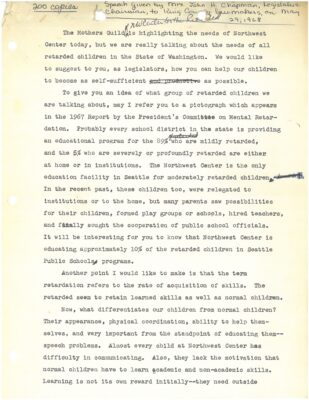
Draft of speech given by Evelyn J. Chapman to King County legislators, 1968.

Draft of speech given by Evelyn J. Chapman to King County legislators, 1968
MOHAI, Chapman Family Collection, 2014.14.1.04.02

Evelyn Johnson Chapman (1935-2016) and John Hume Chapman (d. 2000) married in 1959 and had three children. Their oldest son, Coolidge, was born with brain damage which caused both physical and mental developmental disabilities. Because of this, the Chapmans were not allowed to enroll Coolidge in Seattle Public Schools for kindergarten and instead entered him into an experimental program at the recently formed Northwest Center for the Retarded (now the Northwest Center) in 1966.

This collection consists of papers belonging to the Chapman family related to the schooling of their son, their involvement with the Northwest Center, and papers documenting Evelyn Chapman’s work as part of the Northwest Center legislative committee fighting for “Education for All” legislation in Washington state. This document is a draft of a 1968 speech Evelyn Chapman gave to King County legislators in support of special education.

Collection of J.P. Patches items from Steve Wilson

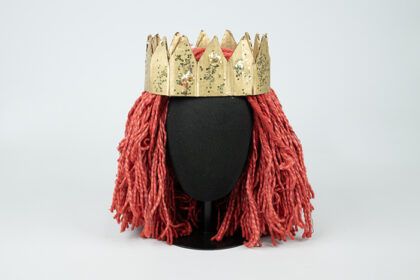
Wig and crown worn by Gertrude on J.P. Patches show, ca. 1970-2000.

Wig and crown worn by Gertrude on J.P. Patches show, ca. 1970-2000
MOHAI, Gift of Steve Wilson, 2024.38.9,RefCrown

Almost Live! director and cast member Steve Wilson is also a huge “Patches Pal” – a fan of the 1958 to 1981 KIRO TV show “The J.P. Patches Show.”

Through friendships with stars Chris Wedes and Bob Newman, Wilson collected a substantial collection of props and costumes from the show, many of which were donated to MOHAI this year.

This mop-head wig and cardboard crown were worn by Newman as J.P. Patches’ girlfriend Gertrude.

Alice Romero and Judith Prinz Ephemera Collection

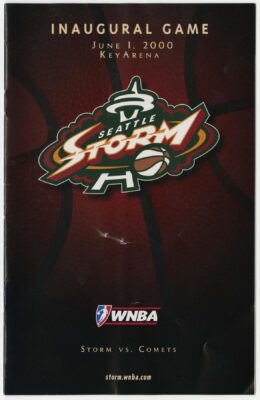
Seattle Storm Inaugural Game program, June 1, 2000 (Storm vs Comets at Key Arena).

Seattle Storm Inaugural Game program, June 1, 2000
MOHAI, Alice Romero and Judith Prinz Ephemera Collection, 2024.48.11.1

The bulk of this collection documents the first 25 years of the WNBA Seattle Storm, through ephemera collected by partners and original season-ticket holders Alice Romero and Judith Prinz. This program documents the Storm’s first game in 2000. Additional items in the collection tell stories from Seattle’s LGBTQ community and local entertainment, politics, and events.

Ervin Schleufer Photographs

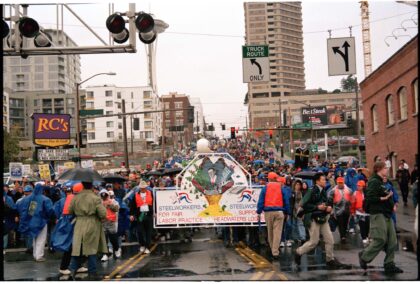
Steelworkers marching to the waterfront in downtown Seattle, WA, December 1, 1999.

Steelworkers marching to the waterfront, December 1, 1999
MOHAI, Ervin Schleufer Photographs, 2024.54.10.03

Ervin Schleufer is a member of the Coeur d’Alene Tribe and retired member of the United Steelworkers of America Local 338. Schleufer was among the striking steelworkers locked out by the Kaiser Corporation in Spokane from 1998 to 2000. In 1999 he traveled the West Coast, with a group calling themselves “road warriors,” to connect with activists, get support for their strike, and raise interest in protesting the WTO conference in Seattle.

Schleufer joined thousands of union members from across the country protesting at the WTO conference and took photos documenting his participation in the street protests. In 2024, Schleufer donated these photographs, including the one shown here, and a signed t-shirt he wore during the protests to MOHAI to support our current exhibit Teamsters, Turtles, and Beyond: The Legacy of the Seattle WTO Protests.

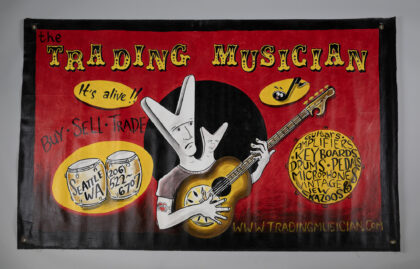
Banner from The Trading Musician, 1999

Banner from The Trading Musician, 1999, shows illustration of a two-headed person (heads in the shape of a Gibson Flying V guitar) playing a dobro.

Banner from The Trading Musician, 1999
MOHAI, Gift of Robin Bartlett-Smith, 2024.Banner

Many in Seattle’s music scene were heartbroken by the news that The Trading Musician would be closing after more than 30 years in business. The store opened in 1991 and its “buy, sell, trade” business model for new, used, and vintage musical instruments was a fresh concept in Seattle at the time. Used instruments were all refurbished by their in-house guitar repair staff and the owners worked hard to make the store a friendly environment for all.

In 1995, they expanded by moving to an old Honda motorcycle shop at the corner of Roosevelt Way NE and Ravenna Boulevard in the University District. The store had an international reputation and customers included members of Pearl Jam, Soundgarden, Los Lobos, Billy Gibbons, and many more. All of the employees were musicians themselves, and the list of former employees includes John McBain of Wellwater Conspiracy, Jason McGerr of Death Cab for Cutie and Sean Lane, drummer for Heart.

This banner was created in 1999 by Tracy Zumwalt, a local tattoo artist, who also created the “V-head” store logo. The logo is an upside-down “Flying V” guitar body inspired by the famous Flying V guitar invented by the Gibson guitar company in 1958. This banner was displayed during Seattle’s Rhythm Festival in 1999 and afterwards was hung in the stairwell of the store. It was donated by store owner and co-founder Robin Bartlett-Smith.

Categories:
Civics

Related Blog Posts

Photograph of MOHAI Oral History Specialist Isabel Bartosh
December 10, 2025

MOHAI Refreshes Its Oral History Transcriptions with Support from 4Culture

Temporary Oral History Specialist Isabel Bartosh working on a transcript, 2024 Over the last 18 months, MOHAI’s Library team has…
Read More
Photograph of curator's fellow Than Tan researching photos in the MOHAI collection.
October 15, 2025

Highlighting Untold Histories of the Pacific Northwest with MOHAI Curator’s Fellows

This year marks MOHAI’s fourth annual Curator’s Fellowship program. Each January, we put out a call for applicants to submit…
Read More